
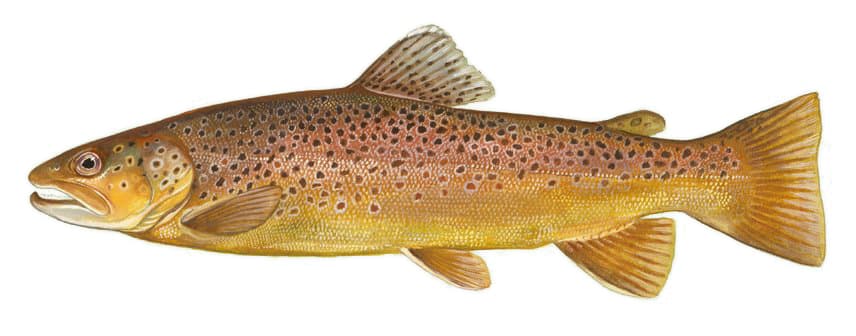
trout
Salmo trutta
The brown trout is the thinking angler's quarry. Originally native to Europe and western Asia, brown trout were first introduced to North American waters in 1883 and have since established thriving populations across the continent. Distinguished by their golden-brown coloring adorned with black and red spots often encircled by pale halos, brown trout are widely regarded as the most difficult trout species to fool with a fly. They are exceptionally wary, frequently nocturnal feeders, and grow larger than most other stream-dwelling trout. Brown trout tolerate warmer water temperatures than their salmonid cousins, allowing them to thrive in waters where other trout species struggle. Trophy brown trout are often caught on streamers fished during low-light conditions, though large specimens also fall to well-presented dry flies during prolific hatches.
Order
Salmoniformes
Family
Salmonidae
Genus
Salmo
Species
S. trutta
Rivers, streams, and lakes with cover such as undercut banks, logjams, and deep pools; tolerates warmer water than other trout up to 75°F
Native Range: Europe, western Asia, and North Africa, from Iceland and Scandinavia south to the Atlas Mountains
Introduced Range: North America, South America, Australasia, East Africa, and southern Asia
Aquatic and terrestrial insects, crayfish, sculpins, small fish, mice, and frogs; larger fish become increasingly piscivorous
Brown trout are fall spawners, constructing redds in gravel substrates from October through December. Females fan out shallow depressions in clean gravel, and eggs incubate through the winter, hatching in early spring. This fall spawning behavior distinguishes them from most other trout.
Spawning Months
Spawning Temperature: 44-48°F
The Brown Trout is currently classified as Least Concern (IUCN) globally; native populations in Europe face localized threats from habitat degradation. Responsible catch-and-release practices help protect populations for future generations of anglers.
Target brown trout during low-light periods at dawn, dusk, and after dark for the best chance at trophy fish. Streamers stripped tight to banks and undercut structure are deadly for large specimens. During daylight hours, precise nymph rigs drifted through deep runs and pools can be highly effective.
A 9-foot 5-weight for general work and a 9-foot 6 or 7-weight for streamer fishing. Use 3X-5X tippet for nymphing and 0X-2X for streamers.
Map loading…

Sight Fishing Paradise at the Bottom of the World
South Pacific

Limestone Spring Creeks and the Birthplace of American Fly Fishing
Mid-Atlantic

Year-Round Tailwater Trout in the Ozark Highlands
Ozarks

The Last Best Place for Fly Fishing
Northern Rockies

spring creek
Brown Trout · Brook Trout

tailwater
Rainbow Trout · Brown Trout · Cutthroat Trout

freestone
Rainbow Trout · Brown Trout · Mountain Whitefish
Average Size
14-22 inches, 2-8 lbs
World Record
44 lbs 11 oz (Ohau Canal, New Zealand, 2020)